
-
Q?
What are NICE Therapeutics and SanaWave?
-
A.
SanaWave is the Innovarius Corp veterinary device: a non-invasive, modulated radiofrequency pulsed electromagnetic field system used by veterinarians in practice. NICE Therapeutics is the name under which the same technology has also been described.
The device delivers modulated radiofrequency energy to a local region of tissue. Its mechanism of action is under active investigation in the company's preclinical research programme and is not yet established.
-
Q?
Who is a good candidate?
-
A.
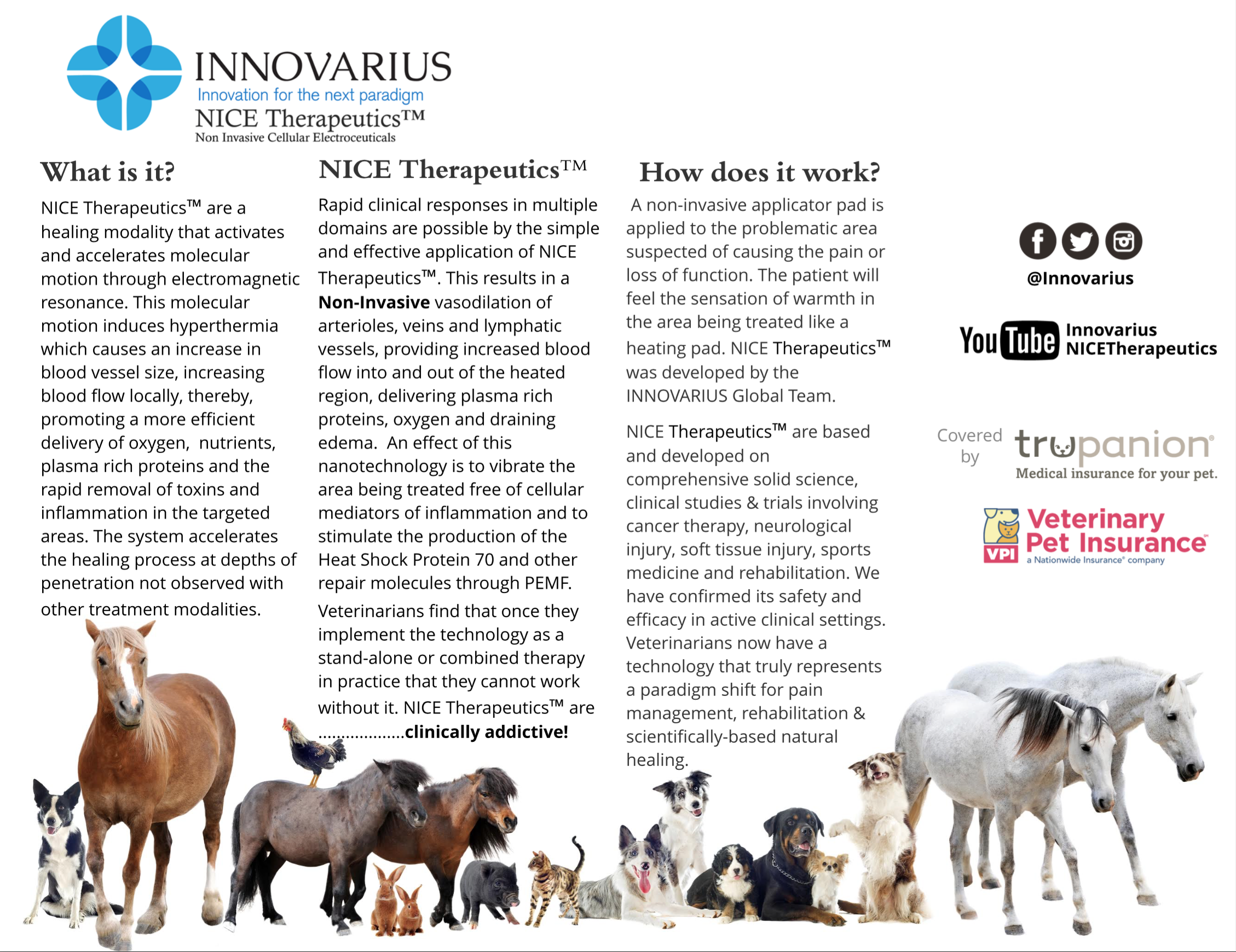
SanaWave has been used in a wide range of species, including horses, cattle, pigs, sheep, goats, dogs, cats, birds and rabbits.
In veterinary practice it is used as part of therapy protocols for pain, inflammation, mobility and recovery, including intervertebral disc disease. Whether it is appropriate for a particular animal is a decision for the treating veterinarian.
-
Q?
How long is a session? How many sessions are needed?
-
A.
Sessions are typically 15 to 30 minutes per area treated, and up to an hour per site depending on the case. In practice a course of one to six sessions per area, usually weekly, is common, and sessions may be repeated as the treating veterinarian judges appropriate.
-
Q?
Are the results permanent?
-
A.
This varies with the animal and with the problem being treated. Some owners report a lasting change; in other cases veterinarians use repeat sessions as maintenance. Durability has not been studied in controlled trials, so your veterinarian is best placed to advise on what to expect.
-
Q?
What does a SanaWave procedure feel like?
-
A.
Most animals tolerate a session well and settle during it. The sensation reported is mild warmth. The procedure is non-invasive and does not require sedation.
-
Q?
Are there any side effects?
-
A.
Reported side effects have been mild and uncommon. Owners have occasionally described increased urination and drowsiness in their pet after a session.
It can help for your pet to drink plenty of water before and after a session. Please contact your veterinarian if you are concerned about anything you notice after treatment.
-
Q?
When can normal activities resume after treatment? How long after treatment?
-
A.
Most animals can return to normal activity after a session, though rest is encouraged. Follow the advice of your treating veterinarian, particularly after an injury or surgery.
-
Q?
When are results felt?
-
A.
Owners and veterinarians have reported changes over a range of timeframes: some within a session or shortly after, and some, particularly where the presenting problem is neurological, over one to two weeks. Response varies between animals and cannot be predicted in advance.
-
Q?
How is it different from a TENS machine?
-
A.
A TENS unit passes an electrical current between two surface electrodes. SanaWave uses a forward-facing applicator to direct radiofrequency energy into tissue. They are different technologies and are not interchangeable.
-
Q?
How is it different from Shockwave Therapy?
-
A.
Shockwave therapy delivers acoustic pressure waves. SanaWave works differently: it uses an ultra high frequency radiofrequency carrier to deliver modulated radiofrequency energy into tissue.
Because the two rely on different physical mechanisms, they have different handling considerations, and the appropriate choice in a given case is a matter for the treating veterinarian.
-
Q?
How is it different to therapeutic ultrasound?
-
A.
Therapeutic ultrasound uses sound waves to produce heat. SanaWave uses an ultra high frequency radiofrequency carrier to deliver modulated radiofrequency energy into tissue.
The two differ in the physics of energy delivery and therefore in how they are applied. As with any modality, whether it suits a particular case is a decision for the treating veterinarian.
Non-invasive radiofrequency therapy for animals